How to Use Your Fireplace Damper
A damper is one of the simplest parts of your fireplace and one of the easiest to get wrong. Here is how to use it correctly and safely.
 Kirk ChandlerLicensed Public Adjuster & Homeowner Advocate
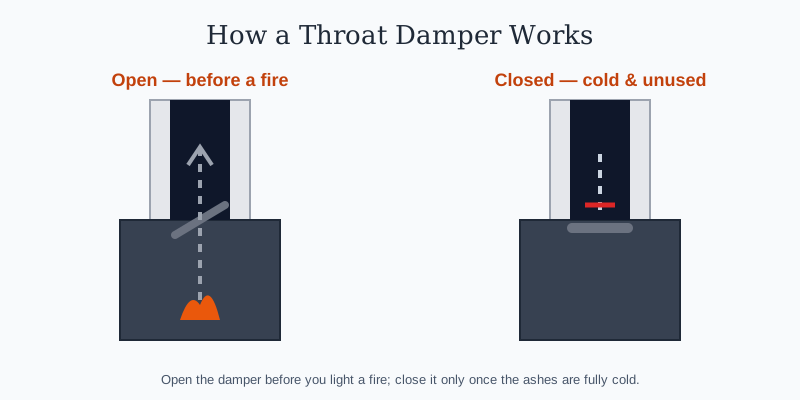
The damper is one of the simplest parts of a fireplace and, oddly, one of the easiest to get wrong. It is a hinged metal plate or valve that sits in the throat of the chimney, just above the firebox, and its whole job is to open the flue when you want a fire and seal it off when you do not. Learning to work it correctly is a basic safety skill — a closed damper over a lit fire will fill your room with smoke in seconds, and at worst creates a genuine fire hazard.
How to know if your damper is open or closed
Before doing anything else, get familiar with your particular damper. Most older masonry fireplaces have a throat damper operated by a handle, lever, or small rotating knob just inside the top of the firebox. Grab a flashlight and look straight up into the fireplace: if you can see up into the flue, it is open; if a metal plate is blocking the view, it is closed. Move the handle back and forth a few times so you can feel and see the plate swing.
Always open the damper before you light a fire
This is the rule that matters most. Check and open the damper before you strike a match, never after. Shine your flashlight up and confirm the plate is in the fully open position. If you wait until the fire is already going to discover the damper is shut, you will be dealing with a room full of smoke while trying to reach a hot metal handle — difficult and dangerous. Make the flashlight check part of your routine every single time.
Close it once the fireplace is completely cold
When the fire is fully out and the ashes have gone cold — not merely quiet, but cold to the touch, which can take many hours — close the damper. An open damper on an unused fireplace acts like an open window year-round, letting your heated air escape up the chimney in winter and your air-conditioned air escape in summer. Closing it also cuts down on the downdrafts that carry that musty creosote smell into the room.
One important caution: never close the damper while there are still live embers. Even coals that look dead can smolder for hours and release carbon monoxide, so a closed damper over warm ashes can push that gas back into your home.
Common damper problems
Throat dampers live directly in the path of heat, smoke, and moisture, so they wear out. In the older housing stock across DC and Baltimore, a rusted throat damper that no longer seals is one of the most common problems pros find — decades of moisture and, closer to the water, salt air corrode the plate until it will not close flush. Watch for these signs that yours is not doing its job:
- A rusted or warped plate that will not seal fully — a common source of drafts, heat loss, and odors
- A damper that sticks, will not stay open, or grinds when you move it
- Creosote and debris built up along the edges, preventing a tight seal
- A persistent smoky smell even when the fireplace is closed, which often means the seal has failed
A better long-term fix: the top-sealing damper
If your throat damper is worn out, one option worth knowing about is a top-mounted, top-sealing damper. Instead of sitting in the throat, it mounts at the top of the flue and closes with a rubber gasket, giving a far tighter seal than a metal throat plate ever will. As a bonus, it doubles as a chimney cap, keeping rain, debris, and animals out of the flue when it is closed.
Frequently asked questions
- Should the damper be open or closed?
- Open whenever there is a fire or hot embers, and closed once the fireplace is completely cold and unused. A top-mounted, top-sealing damper seals better than an old throat damper and also helps keep out rain and animals.
- Why do I feel a cold draft coming from my fireplace?
- It usually means the damper is open or no longer sealing properly. A warped or rusted throat damper lets outside air pour in; a top-sealing damper with a rubber gasket solves persistent drafts far better than an old metal plate.
Need help with this?
Our team provides chimney sweeping & cleaning across Maryland, DC & Northern Virginia. Get a free estimate today.